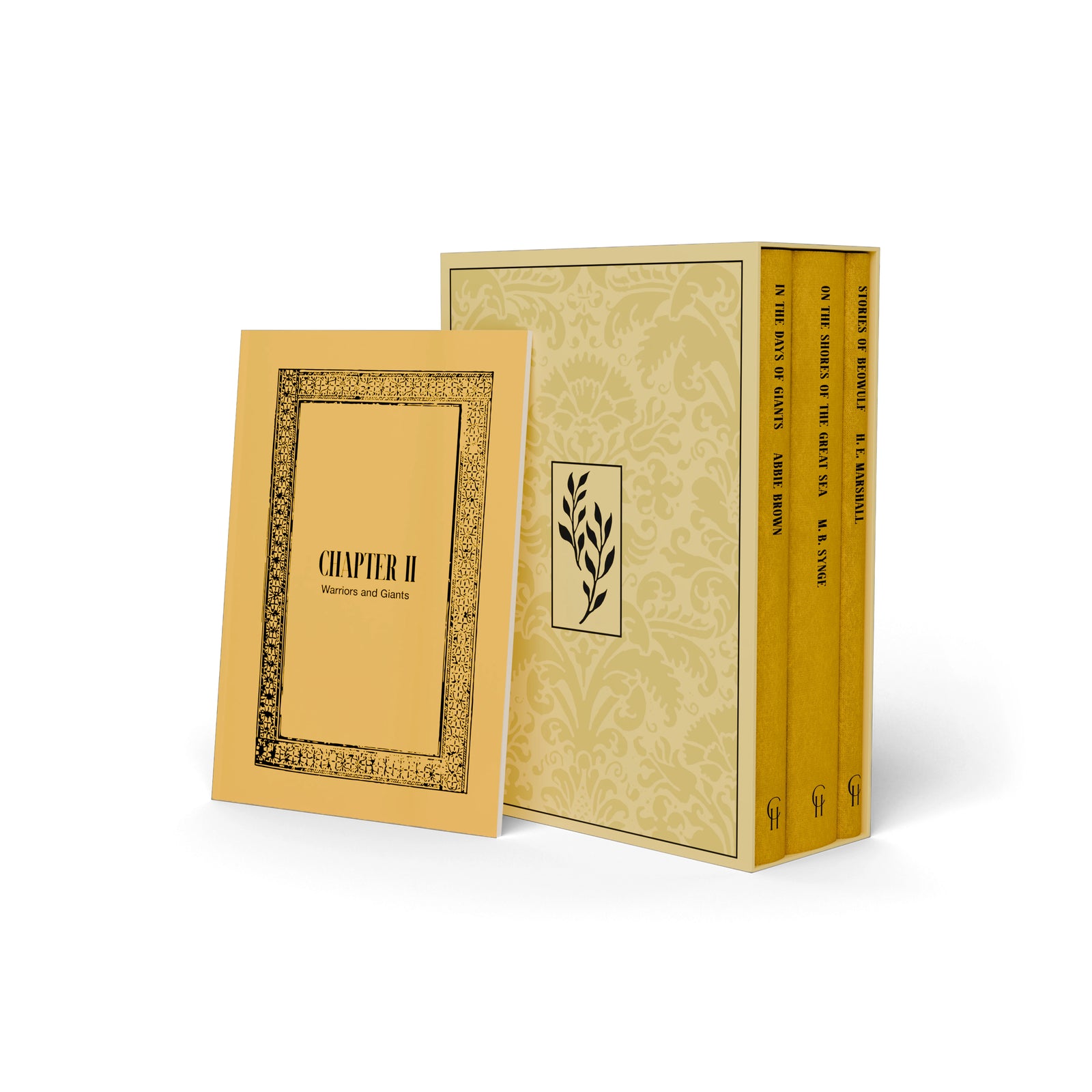
Chapter II: Warriors and Giants
Add to your order
CHAPTER II BOX SET
This is the widening of the world: the first encounter with ancient history, Norse mythology, and heroic literature. Chapter II carries children from the great civilizations of the ancient Mediterranean to the strange northern world of Odin, Thor, and Beowulf.
We recommend adding the Second and Third Grade bundles to extend that work into daily practice through mathematics, handwriting, grammar, geography, music, art, and a growing library of more demanding books.
- On the Shores of the Great Sea
- In the Days of Giants
- Stories of Beowulf
- Companion Pamphlet
ABOUT THE BOOKS
On the Shores of the Great Sea
M. B. Synge's On the Shores of the Great Sea (1903) is one of the finest history books ever written for children. It tells the story of the ancient Mediterranean world (Egypt, Phoenicia, Israel, Persia, Greece, and Rome), not as a catalog of facts, but as a continuous narrative in which one civilization gives way to the next and every event grows out of the ones before it. Joseph is sold into slavery. Moses parts the Red Sea. The Greeks fight at Marathon. Alexander weeps because there are no more worlds to conquer. Caesar crosses the Rubicon. And at the end of the book, Rome stands at peace, waiting for something it does not yet know it is waiting for.
Synge frames her story through the Mediterranean itself (what the Bible calls the Great Sea- does it?), and the effect is to show children that history is not a collection of isolated episodes but a single story unfolding across centuries. Biblical and secular history stand side by side without apology, because in the ancient world they were not separate.
This Chapter House edition features three new color illustrations by Cortney Skinner. It is the first book in Synge's five-volume "Story of the World" series; the second volume, The Discovery of New Worlds, continues the narrative in Chapter III.
Ages 7–10 | 2nd–4th grade
In the Days of Giants
Before Thor was a movie character, he was a god. Before Loki was a pop-culture villain, he was a trickster whose cleverness brought both laughter and ruin to Asgard. And the actual stories (the ones from the Norse Eddas, not the films) are stranger, funnier, and more interesting than anything Marvel has put on screen. Odin did not lose his eye in battle. He sacrificed it willingly, paying for a single drink from the well of wisdom. Thor's hammer does not give him the ability to fly; he has a chariot pulled by two goats. Loki is not Thor's brother. He is his occasional companion and frequent tormentor.
Abbie Farwell Brown's In the Days of Giants (1902) retells sixteen Norse myths with the drama and dry humor they deserve. These are stories about sacrifice, cunning, loyalty, the price of pride, and the acceptance of fate. They are also, frankly, thrilling, which matters when you are trying to put a book in the hands of a seven-year-old boy.
In Charlotte Mason education circles, In the Days of Giants is known as a "stretching book": One that is just beyond a child's comfortable reading level, requiring real effort and rewarding it. The names are unfamiliar, the world is alien, and the effort of working through both makes better readers.
This Chapter House edition restores all six of E. Boyd Smith's original full-page illustrations, a feature no other in-print edition provides.
Ages 7–10 | 2nd–4th grade
Stories of Beowulf
Beowulf is the oldest surviving long poem in Old English and one of the foundational texts of English literature. It was one of J. R. R. Tolkien's chief inspirations for The Lord of the Rings; children who read Marshall's retelling may recognize Grendel in the orcs, the dragon's hoard in Smaug's treasure, and Beowulf's final sacrifice in Aragorn. The roots of modern fantasy are here, and they are worth knowing.
H. E. Marshall's Stories of Beowulf brings the three great episodes of the poem within reach of a seven-year-old without shrinking them. Grendel is terrifying. The Water Witch is dark. The Dragon is real enough to give children nightmares is this something we want to say?. Marshall does not water it down; she trusts her young readers to handle the weight of the story. Her prose is elevated enough to feel like an epic and clear enough to follow at a sitting.
The story unfolds in three acts: Beowulf defeats the monster Grendel bare-handed in King Hrothgar's hall; descends into a dark underwater lair to face Grendel's mother; and, years later as an old king, faces a fire dragon knowing he will not survive. These are stories about courage in the face of certain danger: The same courage that Lewis had in mind when he wrote, "Since it is so likely that children will meet cruel enemies, let them at least have heard of brave knights and heroic courage."
This Chapter House edition includes three original illustrations by T. W. C. Shaw-Taylor.
Ages 7–10 | 2nd–4th grade
The Chapter II Pamphlet
The companion pamphlet, included with every Chapter II box set, is a full introduction to the books, the philosophy behind them, and the practice of reading them well.
Contents of the Chapter II pamphlet:
-
"Virtus et Miraculum": The founding essay of Chapter House. An argument for why virtue is the proper aim of education and why story is the best way to cultivate it, drawing on Aristotle, Marcus Aurelius, Benjamin Franklin, John Adams, Confucius, and St. John Chrysostom.
-
Introduction to Chapter II: Warriors and Giants: An overview of all three books and how they fit together.
-
Literary Essays: Individual essays on Synge's method in On the Shores of the Great Sea, the Norse myths that Marvel got wrong in In the Days of Giants, and the importance of Beowulf, including a discussion of why the 2007 Zemeckis film adaptation is a corruption of the original and why it matters.
-
How to Enjoy These Titles with Your Children: Practical guidance on the "ping pong" reading approach, narration, and pacing for the early elementary years.
-
A Sample Day with Chapter II: A full sample daily schedule showing how the Chapter House books fit alongside mathematics, handwriting, nature study, and other subjects.
-
An Introduction to Homeschooling: For families new to home education.
-
A Survey of Educational Philosophies: Charlotte Mason, Classical, Montessori, Waldorf, and Orton-Gillingham approaches.
-
Why You Should Read the Bible: A case for biblical literacy regardless of faith background, with a reading list.
-
A Note to Christian Parents Apprehensive About Ancient Mythology: A thorough response to concerns about pagan mythology, drawing on St. Paul, St. Basil the Great, J. R. R. Tolkien, and C. S. Lewis.
-
Greek vs. Roman Names: A reference table for the gods and heroes who appear in multiple forms across the series.
Free U.S. shipping on orders over $75. International shipping available. 30-day return policy for undamaged items.